Genoa Corporate Tours | Professional Tourist Guide
Corporate guided tours in Genoa for teams, guests, delegations, conferences and business events. Clear, well-organised and customised cultural itineraries.
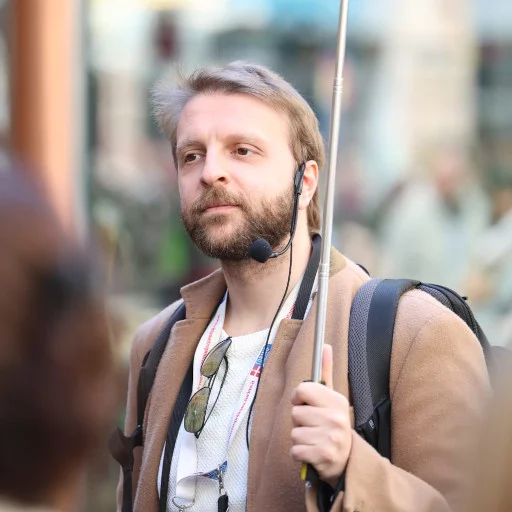
Genoa Corporate Tours: guided visits for teams, guests and business groups
Organising a corporate tour in Genoa does not simply mean booking a guided visit. Anyone coordinating an event, a meeting, a conference or the reception of business guests needs several elements to work together: timing, transfers, language, group composition, level of formality, starting and ending points, and any connection with a dinner, meeting or wider programme.
A guided tour in Genoa for companies should be enjoyable, of course, but first of all it should be clear, well organised and suitable for the context. A group of international clients does not have the same needs as an internal team visiting the city. An institutional delegation requires a different tone from an informal cultural activity among colleagues. A tour scheduled between a meeting and a dinner must respect precise timing, without feeling rushed or scattered.
As a tourist guide in Genoa, I offer itineraries designed for companies, event agencies, DMCs, hotels, conferences, delegations and business groups that wish to include the city in their programme in a credible and well-managed way. The aim is to help participants understand Genoa: its historic centre, the Palazzi dei Rolli, the old port, Strada Nuova, the relationship with the sea, art, local history and traditions, without reducing everything to a sequence of anecdotes or to a generic walk.
Before the itinerary: understanding the organiser’s needs
A company representative or event organiser usually looks for a practical proposal: how long the tour lasts, where it starts, where it ends, what the group will see, what pace the visit will have, which language is needed, and how much detail is appropriate. These are practical questions, but they are essential.
For this reason, before suggesting an itinerary, it is useful to understand the context. Is the tour part of a corporate event? Is it intended to welcome clients or partners? Is it a lighter moment after a working day? Do the participants already know Genoa, or are they visiting it for the first time? Does the group have very limited time, or can it dedicate half a day to the city?
A Genoa corporate tour works well when it is not copied from a standard visit, but shaped around the actual needs of the group. Sometimes a compact introduction to the city is needed, suitable also for those with limited time. In other cases, a more cultural route is preferable, with a historical and artistic focus. For foreign guests, it may be important to offer a simple but not superficial key to understanding the city: why Genoa is distinctive, how it developed, and what role the port, trade, noble families, palaces and historic centre have played.
Who the corporate tour in Genoa is designed for
This service is intended for organisations that need to arrange a professional guided tour, with attention both to content and to group management.
It may be suitable for companies wishing to offer a cultural activity to employees, clients or partners during a visit to Genoa. It may be useful for event agencies and DMCs designing tailor-made programmes for corporate groups, incentive trips, meetings and conferences. It may also interest hotels and accommodation facilities that welcome business guests and want to suggest a reliable guided tour consistent with the profile of the group.
The tour can also be planned for delegations, institutional guests, conference participants, internal teams, professional groups, event companions or people arriving in Genoa for a convention who have limited time to get to know the city.
In all these cases, the focus is not only on “what to see”, but also on “how to do it”: with a sustainable pace, language suitable for the audience, a realistic duration and a proposal that is easy to understand for those who need to approve it or include it in a programme.
What kind of itineraries can be organised
A corporate tour in Genoa can take different forms, depending on the time available and the type of group.
A classic route may focus on the historic centre, the caruggi, the main squares and the places that help visitors understand the structure of the city. This is a good solution for those visiting Genoa for the first time and wanting an overview, without getting lost in an itinerary that is too long or fragmented.
For groups interested in art, history and the image of aristocratic Genoa, a visit can be built around Strada Nuova and the Palazzi dei Rolli, with an approach also suitable for clients, partners or international guests. In this case, the route can help explain the role of Genoese families, the construction of the noble city and the relationship between architecture, power and representation.
Another possibility is an itinerary dedicated to Genoa and the sea, with references to the old port, maritime history, commercial exchanges and the bond between the city and the Mediterranean. This theme is particularly suitable when the group comes for professional reasons connected with logistics, yachting, trade, industry or, more simply, when the aim is to present Genoa starting from its port identity.
When time is limited, it is possible to design a short tour between a meeting and a dinner, or an introductory visit before an evening event. In these cases, choosing the right route is important: a compact itinerary with a few meaningful stops is preferable to an overly ambitious visit that risks feeling rushed.
For foreign guests or mixed groups, the itinerary can be set at a balanced level of depth: rich enough to give the visit substance, but not so specialised that it becomes difficult to follow after a working day or during an already intensive programme.
How the organisation works
Organising a guided tour for corporate events in Genoa starts from a few essential details. The date, approximate number of participants, desired duration, requested language, starting point and ending point help define the most suitable route.
In a corporate context, logistics matter. It may be necessary to start from a hotel, a conference venue, a terminal, a point close to the dinner location or an area that is easy for the group to reach. The final point should also be considered carefully, especially if transfers, appointments or convivial moments are scheduled after the tour.
Duration may vary according to the programme, but it is important to be realistic. A short tour can work well if it has a clear objective. A longer visit allows for a deeper understanding of the city, but it must be compatible with the group’s energy level and with the other commitments of the day.
The number of participants also affects the management of the tour. A small group allows for more dialogue and flexibility. A larger group requires more structured organisation, more time for movement and careful evaluation of spaces. For very large groups, it may be advisable to consider different solutions, to be assessed according to the context and composition of the participants.
The language should be indicated from the beginning, especially when international guests are involved. It is also useful to clarify whether the group prefers a more institutional, more accessible or more informal tone. Not all corporate tours have the same register: an activity for an internal team may be more conversational, while a visit for clients or delegations may require a higher level of formality.
What makes a corporate tour different from a generic group visit
A Genoa tour for corporate groups is not just a guided visit with many participants. The difference lies in the way the route is planned and managed.
In a generic tour, the starting point is often the itinerary. In a corporate tour, the starting point is the context: who is taking part, why they are in Genoa, how much time they have, what image of the event should be conveyed, and what role the visit has within the programme.
This also changes the way the city is presented. There is no need to turn Genoa into a tourist backdrop, nor to overload the group with information. It is more useful to select places and themes that help participants find their bearings: the relationship between the historic centre and the port, the medieval city and the aristocratic city, the presence of the palaces, urban transformations, the sea, local traditions, and the practical yet complex character of Genoa.
For a company, a well-designed guided tour can become a moment of welcome, a cultural break, a shared activity or a way to give value to being in the city. It does not necessarily have to be presented as “team building” in the strict sense. Sometimes it is simply an opportunity to help people better understand the place where a professional meeting is taking place.
Useful information for requesting a proposal
To prepare a clear proposal, it is useful to provide some information from the first contact.
The date and time are the first elements to check, especially if the visit is included between other appointments. It is important to know whether the tour needs to start or end in a specific place, such as a hotel, event venue, restaurant, conference area, old port or city centre.
The number of participants makes it possible to assess pace, management and suitability of the route. Even an initial estimate is useful; the final number can be updated later, if needed. The desired duration helps determine whether to suggest an introductory visit, a more complete route or a very focused itinerary.
The requested language should be specified clearly, together with the profile of the group: internal team, clients, partners, international guests, delegation, accompanying persons or conference participants. It is also useful to indicate the desired level of depth: panoramic, cultural, historical-artistic, focused on the city and the sea, or lighter and suitable for an informal moment.
Any specific needs — tight timing, participants with reduced mobility, the need to avoid routes that are too long, connection with a dinner or transfer — should be mentioned from the beginning. Some practical information may change over time or depend on external conditions, so it is always advisable to check it before the visit.
A corporate guided tour to understand Genoa better
Genoa is a city that often needs a key to be read properly. It does not always reveal itself at first sight: the historic centre is dense, routes are not always intuitive, palaces may appear discreet from the outside, and the relationship with the sea is more complex than it may seem. This is precisely why a local guide can help a corporate group move through the city with greater awareness, choosing places and themes that are coherent with the time available.
A tourist guide in Genoa for companies does not only serve to “explain monuments”. The guide helps give order to the visit, avoid dispersion, select what makes sense to see in that specific context and make the experience accessible even to those with no specific knowledge of the city.
The result should be a sober, well-conducted and interesting visit, compatible with the corporate programme. Not a filler, but a moment planned with care.